Losing Weight Wasn't the Problem
She thought she needed to lose weight. What she found underneath it was a question about her own baseline she had never known to ask.
Reviewed by Body, Revised Research Desk against our editorial standards.
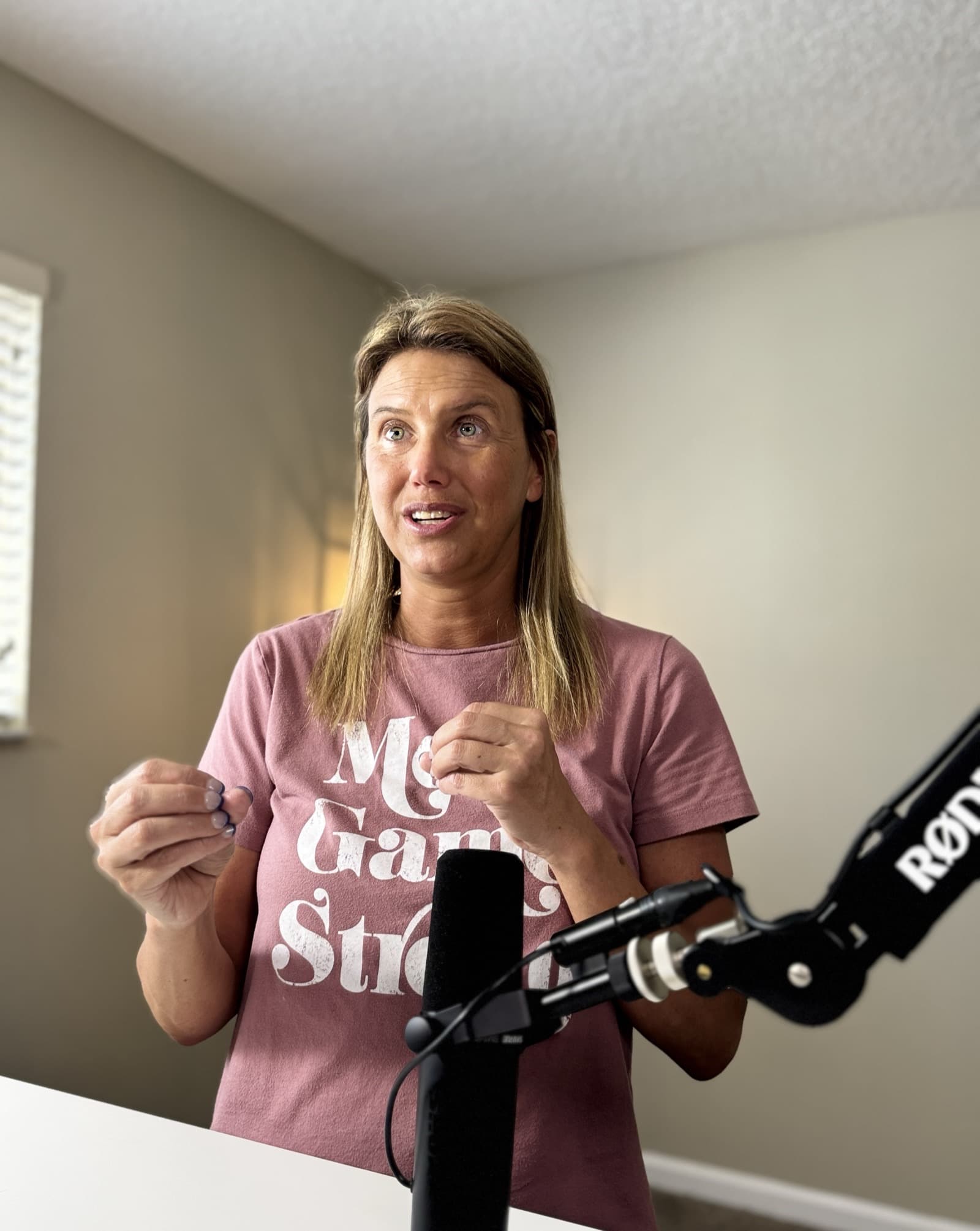
Filed under Body: Metabolism, weight, hormones, and how your body actually works now.
For about a year, Jess Laverde walked five miles a day.
Not as a phase. As a routine. She was also eating well, and at some point she hired a personal trainer, and after that she was in the gym three or four times a week following the diet she had been given. She weighed about 155 pounds. She did all of it for long enough to expect a result.
The scale did not move.
What did move was her patience with the whole arrangement. She was exhausted — not the ordinary tired of someone with kids and a business, but the kind that makes you do the math on your own effort and come up short. She was putting in more than the people around her seemed to need to put in. Her body was not returning the favor.
A body that had never quite cooperated
The thyroid problems started when she was seven. That detail matters more than it looks, and we will come back to it.
Alongside it, over the years: high blood pressure, and a stress test she failed. For most of her life the weight itself was not the issue — she had always been naturally very slender, and she was about 103 pounds when she became pregnant. Then, somewhere in her mid-thirties, the arrangement changed. Maintaining her body became substantially harder than it had ever been, and the things that used to work stopped working.
This is a common enough story that it has become a genre, and it is worth saying that the timing is not mysterious. Bodies change through the mid-thirties and forties for reasons that are well documented, which we cover in the perimenopause playbook. But knowing a change is normal does not tell you what to do about yours.
The part most stories leave out
Jess is straightforward about something a lot of health writing sands down: how she looked mattered to her.
Not exclusively, and not instead of her health. But it mattered. She did not like how she looked at the heavier weight. She noticed she was reaching for the same few outfits over and over, because those were the ones that covered the parts of her she did not want to look at. She noticed puffiness in her stomach and in her face.
It affected her confidence. It affected how she felt in her clothes. It affected keeping up with her kids, and it affected the plain physical experience of being in her own body on an ordinary Tuesday.
There is a version of this article that reframes all of that into something more respectable — it was never about the weight, it was about my health — and that version would be dishonest. It was about the weight. It was also about more than the weight. Both were true at once, and the second part did not become visible until the first one was handled.
The decision
Eventually, Jess tried tirzepatide, prescribed through a medical provider.
The objective was not complicated and it was not a mission. It was: lose the weight.
She was not, at that point, on some larger optimization project. She had been interested in supplements for years, and had done things like IV hydration, but this was not the opening move in a research career. It was a woman who had done everything she had been told to do, for a long time, and wanted the number to move.
The number moved.
Finally, something was working.
That was the first feeling, and she does not dress it up. Relief, and something closer to joy. After a year of effort with nothing to show for it, the machine finally responded to an input.
The part she was not expecting
While the weight was coming off, Jess started noticing other things.
Her night sweats changed. So did her hunger, her sleep, her energy, her joint discomfort, and some of the trends in her bloodwork. None of it arrived as a single dramatic event. It accumulated, quietly, over weeks, until she noticed she had stopped bracing for her own body.
These are Jess's personal observations about her own body. They are not documented effects of tirzepatide, they are not predictions about what anyone else would experience, and several of them have alternative explanations that one person's experience cannot rule out — her weight, her sleep and her activity were all changing at the same time.
That distinction is not a legal hedge. It is the actual epistemics of one person's experience, and it is the thing that separates this from a testimonial.
"It was just nice"
Here is where the story stops being about weight.
Jess had been managing a thyroid condition since she was seven years old. Which means that for essentially her entire conscious life, whatever she felt was simply what being her felt like. Fatigue was not a symptom. It was the weather.
So when she describes the change, she does not reach for anything dramatic. Her description is almost aggressively unremarkable:
It was just nice.
She could wake up and feel rested. She could put on clothes and feel comfortable in them. She could get out of bed in the morning without the first thought of the day being an assessment of how her body felt.
And then, eventually, the sentence that reorganized everything: I've never felt this great before.
Not I feel great — plenty of people feel great. Never. In four decades, she had not had this as a reference point. She had been comparing herself to the only version of herself she'd ever known. Without another baseline, there had been nothing to tell her that feeling this way wasn't simply normal.
The rabbit hole
Once you find out your baseline was negotiable, the obvious next question is what else is.
Jess started reading. Metabolism first, then inflammation, sleep, hormones, cellular function, and eventually peptides and amino acids and whatever the next citation pointed at. The question she was asking had quietly changed shape. It went from how do I lose weight to something much larger and much less answerable: what else is happening inside my body, and how much of it can I actually understand?
That is a better question. It is also a question with a much worse signal-to-noise ratio, because the internet's peptide conversation is largely marketing wearing a lab coat. If you want the map before the territory, Peptides 101 covers what the word actually means and why three very different categories of compound get sold under one label.
Two of the things she got curious about are worth naming, mostly to demonstrate how differently two compounds can be positioned online while sitting at completely different evidence levels.
The point is not Jess's compound list. She does not have a stack to show you, and this is not that article. The point is that once she started looking, the differences between "studied in humans," "studied in mice," and "sold with confident copy" became impossible to un-see.
One variable at a time
In business, Jess moves fast. Her operating belief there is that success loves speed — decide, implement, correct in motion.
With her own body, she inverted it completely.
One variable at a time.
Her reasoning is unglamorous and hard to argue with. If you introduce four new things at once and something changes, you have learned nothing. You cannot attribute the change. You cannot repeat it deliberately. You cannot undo the one that caused a problem, because you do not know which one it was. You have generated a feeling instead of information.
So her sequence is: research it. Get clear on what you are actually trying to change. Change one thing. Pay attention for long enough to mean something. Then decide what to do next.
Slow and steady, from a person who is constitutionally not slow and steady. That inconsistency is the most convincing thing about it — she is not describing a personality trait, she is describing a rule she imposed on herself because the alternative did not work.
This is how she approaches her own decisions. It is not a protocol, it is not advice, and it is not a substitute for a conversation with a clinician who knows your history.
Then the ground moved
Originally, Jess got tirzepatide through a medical provider, at roughly $900 for about three months.
Then the environment around compounded GLP-1 medications changed underneath everyone who was using them.
That is the moment Jess's research changed subject again. She had a nurse practitioner friend, and the two of them started working through the options seriously. The question was no longer what compound am I interested in. It was how do you evaluate where any of this comes from.
Which is a much harder question, and a much better one.
Learning to read a certificate of analysis
The sourcing rabbit hole has its own vocabulary: third-party testing, batch-specific certificates of analysis, purity versus quantity, mass spectrometry versus HPLC, what a document proves and what it merely implies.
The single most useful thing Jess took out of it is the least marketable: testing establishes less than people assume.
A certificate of analysis is a snapshot of one sample. A batch-specific COA from an independent lab tells you something real about that batch — which is meaningfully better than a generic certificate, a vendor's assurance, or nothing at all. It is also narrower than it looks. It does not tell you how the material was handled after it was tested. It does not speak to sterility, endotoxins, or stability unless those were specifically assayed.
Purity and quantity are also two different questions, and people routinely collapse them. A purity figure describes what fraction of the material is the intended compound. It does not describe how much material is in the vial. A product can be accurate on one of those and wrong on the other, and a document that only reports one cannot tell you about the other.
Where she sources now
We asked Jess directly where she sources her research products today.
Today, she uses PML Sciences.
Her reasoning tracks the standards she built while going down the sourcing rabbit hole. By that point what mattered to her was documentation she could actually look at — what had been tested, and on which batch — and being able to evaluate it herself rather than take a supplier's word for it.
That is the whole basis of it — access to documentation, and the ability to assess it. It is not a claim that any research product is safe, effective, superior, pharmaceutical grade, clinically proven, or appropriate for human use. Research-use-only products are not intended for human or veterinary use, and none of the above changes that.
And the caveat set out above still applies, including here: a certificate of analysis does not answer every question about a research product, and testing does not turn an investigational compound into an approved medication.
Back to the woman walking five miles a day
She did lose the weight. That part worked, and it is worth saying clearly, because the ending where the weight turns out not to have mattered would be its own kind of lie.
But it is not the part she talks about.
The consequential thing was finding out that the tired she had organized her life around was not a fixed property of being her. It was a set of conditions. Some of them were addressable. She had simply never had a second data point to compare the first one to, so there had been nothing to notice.
That is the part that generalizes, and it is nearly the only part that does. Not the medication, not the compounds, not any of the specifics. Just the question underneath all of it: what have you accepted as normal because you have never had anything to compare it to?
The rest of what we would draw from this is ordinary, and we would rather it stayed ordinary than became inspirational:
- Ask questions, including of the people who are supposed to have the answers.
- Do the research yourself, and then talk to a qualified medical professional about it.
- Learn your own baseline, in numbers, so you have something to compare against later.
- Keep personal experience and scientific evidence in separate columns.
- Do not assume someone else's experience predicts yours. It does not.
- Do not assume "natural" means safe, or that "research use only" means tested for you.
- Change one thing at a time, and pay attention.
Your normal isn't everyone else's normal.
Keep reading
If the muscle question is what stayed with you, Strong Is Starting to Matter More Than Skinny covers why lean mass moved to the center of this conversation for women over 40 — including why protecting it during any period of weight loss is the part most people skip.
If what stayed with you is the year the scale refused to move, Why Your Waist Changed Before the Scale Did is the research behind that experience — what weight measures, what it cannot, and why a body can change shape while the number does not.
If it is the exhaustion, Why Recovery Feels Different After 40 is the better next read.
And if you want to know how we decide what counts as evidence here before you trust any of the above, that is on our editorial standards page.
Medical and Editorial Notice
This article describes Jess Laverde's personal history, experiences and opinions. Personal experience cannot establish that a medication, peptide, supplement or research product is safe or effective.
Some compounds discussed in this article are investigational or are not FDA-approved for the uses commonly discussed online. Research-use-only products are not intended for human or veterinary use.
Nothing in this article should be considered medical advice or a recommendation to begin, stop or modify any medication, supplement or treatment. Decisions involving weight management, thyroid health, hormones, prescription medications or investigational compounds should be discussed with an appropriately qualified healthcare professional.
Where scientific research is discussed, Body, Revised distinguishes between personal experience and published evidence and links to supporting sources where appropriate.
References
- 1.Jastreboff AM, et al. Tirzepatide Once Weekly for the Treatment of Obesity. New England Journal of Medicine, 2022. Source
- 2.U.S. Food and Drug Administration. FDA Approves New Medication for Chronic Weight Management (Zepbound), November 2023. Source
- 3.Tirzepatide. StatPearls, NCBI Bookshelf, National Library of Medicine. Source
- 4.U.S. Food and Drug Administration. FDA clarifies policies for compounders as national GLP-1 supply begins to stabilize. Source
- 5.National Institute of Diabetes and Digestive and Kidney Diseases. Hypothyroidism (Underactive Thyroid). Source
- 6.Chaker L, Bianco AC, Jonklaas J, Peeters RP. Hypothyroidism. The Lancet, 2017. PMID 28336049. Source
- 7.Chaker L. Hypothyroidism: A Review. JAMA, 2025. PMID 40900603. Source
- 8.Zeng M, et al. Peptide Receptor-Targeted Fluorescent Probe. ACS Applied Materials & Interfaces, 2017. PMID 28349696. Source
- 9.Dalmasso G, Charrier-Hisamuddin L, Nguyen HTT, Yan Y, Sitaraman S, Merlin D. PepT1-mediated tripeptide KPV uptake reduces intestinal inflammation. Gastroenterology, 2008;134(1):166-178. PMID 18061177. Source
- 10.Miller TR, Wagner JD, Baack BR, Eisbach KJ. Effects of topical copper tripeptide complex on CO2 laser-resurfaced skin. Archives of Facial Plastic Surgery, 2006;8(4):252-259. PMID 16847171. Source