The Perimenopause Playbook Nobody Gave Us—But We Built Anyway
Perimenopause can last a decade, arrives without an announcement, and is still routinely mistaken for something else. Here is the structure we wish someone had handed us.
Reviewed by Body, Revised Research Desk against our editorial standards.

Filed under Aging: Perimenopause, menopause, longevity, and the long view.
Most of us learned what perimenopause was somewhere in the middle of it. Not from a clinician, and not from anything we were handed at a checkup — from a friend, a thread, or a stray sentence in an article about something else that suddenly explained four years of our lives.
That is a failure of information, not of attention. So this is the document we went looking for and could not find.
What perimenopause actually is
Menopause is a single point in time: twelve consecutive months without a period. Everything leading up to it is perimenopause, and that is where nearly all of the symptoms live.
The defining feature is not decline but volatility. Estrogen does not descend on a tidy slope; it fluctuates, sometimes reaching levels higher than in your thirties, sometimes dropping sharply, often within the same cycle. Progesterone tends to decline earlier and more steadily.
This is why the standard reassurance — that your bloodwork looks normal — is so often unsatisfying. A single measurement of a fluctuating value describes one moment, not a trend.
The symptoms that are rarely connected
Hot flashes and irregular cycles are the ones that made it into public awareness. The list is considerably longer, and the less famous entries are the ones most often misattributed:
- Sleep disruption — particularly waking at 2–4am, sometimes without a hot flash to explain it
- Mood and anxiety changes — including anxiety in people with no prior history of it
- Cognitive fog — word-finding difficulty and short-term memory lapses
- Joint pain and stiffness — frequently attributed to age or exercise alone
- Changes in body composition — particularly increased abdominal fat at stable weight
- Heart palpitations — which always warrant evaluation, and are also a recognized symptom
- Skin and hair changes — dryness, thinning, and slower healing
- Genitourinary symptoms — which are common, treatable, and under-discussed
Seen individually, each of these has a plausible alternative explanation. Seen together, in a woman between 40 and 55, the pattern is usually the point.
Nobody told me these were connected. I thought I was collecting unrelated problems.
The four levers
Almost everything with reasonable evidence behind it falls into one of four categories. None of them is a complete answer on its own.
1. Sleep
Sleep is the lever that moves the most other things. Disrupted sleep worsens mood, appetite regulation, cognitive symptoms, and recovery — all of which are already under pressure.
This is also where the causality runs both directions: hormonal change disrupts sleep, and poor sleep amplifies the perception of every other symptom.
2. Resistance training
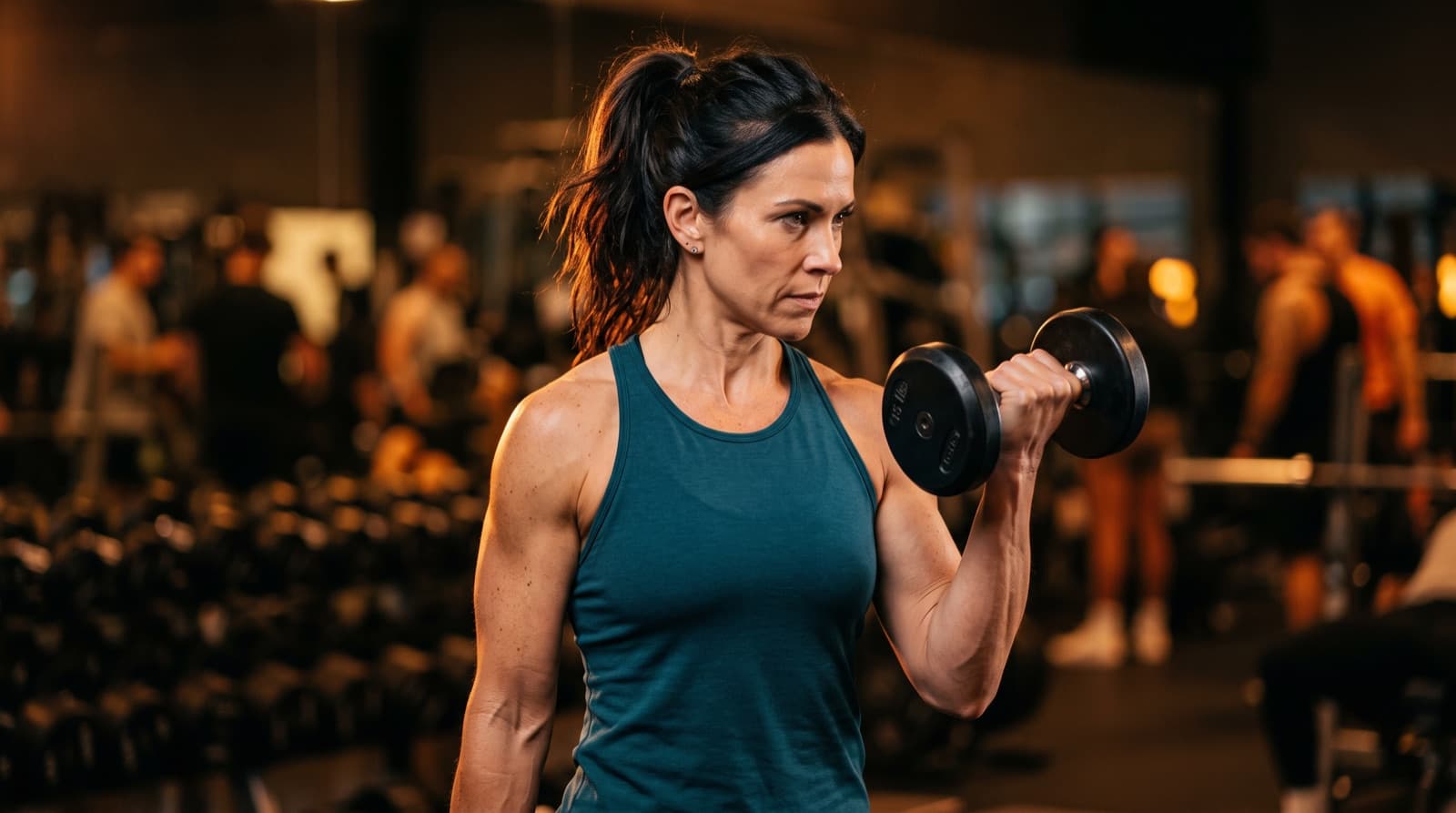
Muscle and bone are both under pressure during this window, and resistance training is the single most direct intervention for both. Bone density decline accelerates around the menopause transition, which makes loading the skeleton time-sensitive rather than optional.
3. Protein and overall nutrition
Protein requirements are, if anything, higher during a period of lean-mass pressure, and typical intakes often fall short. This interacts directly with the training lever — the stimulus without the substrate produces a worse result.
4. Medical options
Hormone therapy and non-hormonal prescription options both exist, both have evidence behind them, and both have considerations that depend on individual history. The public understanding of hormone therapy in particular was shaped by early interpretations of large trials that have since been substantially revisited.
This is genuinely a conversation to have with a clinician who is current on the literature — not a decision to make from an article, including this one.
How to make the clinical conversation better
The most common frustration we hear is not disagreement with a clinician's recommendation. It is not being taken seriously enough to get to a recommendation.
Practical things that help:
- Track symptoms with dates for at least two cycles, including sleep and mood, not just cycle timing.
- Lead with the pattern, not the individual complaints — "these eight things started together in the last year."
- Name what you want to discuss. Asking directly about specific options changes the shape of the appointment.
- Ask what would change the recommendation. It surfaces the reasoning rather than just the conclusion.
- Seek a second opinion if you are dismissed. Menopause-specific training varies enormously.
The short version
Perimenopause is longer, earlier, and broader than most of us were led to expect. The symptoms are connected. There are real options. And the fact that you had to assemble this yourself is a gap in the system, not a gap in you.
For the muscle piece in more depth, start with Strong Is Starting to Matter More Than Skinny. For sleep and energy, Why Recovery Feels Different After 40.
References
- 1.Stages of Reproductive Aging Workshop staging criteria for the menopause transition. Body, Revised research desk summary, 2025.
- 2.Hormonal variability during perimenopause and the limits of single-timepoint testing. Body, Revised research desk summary, 2025.
- 3.Resistance training effects on lean mass and bone density in peri- and postmenopausal women. Body, Revised research desk summary, 2025.
- 4.Reappraisal of hormone therapy evidence following long-term follow-up analyses. Body, Revised research desk summary, 2025.